The 15-yard dumpster measures roughly 14 feet long, 7.5 feet wide, and 4.5 feet tall, holding about 15 cubic yards, the equivalent of around 6 full-size pickup loads. It is the middle size between the 10-yard ($595)…
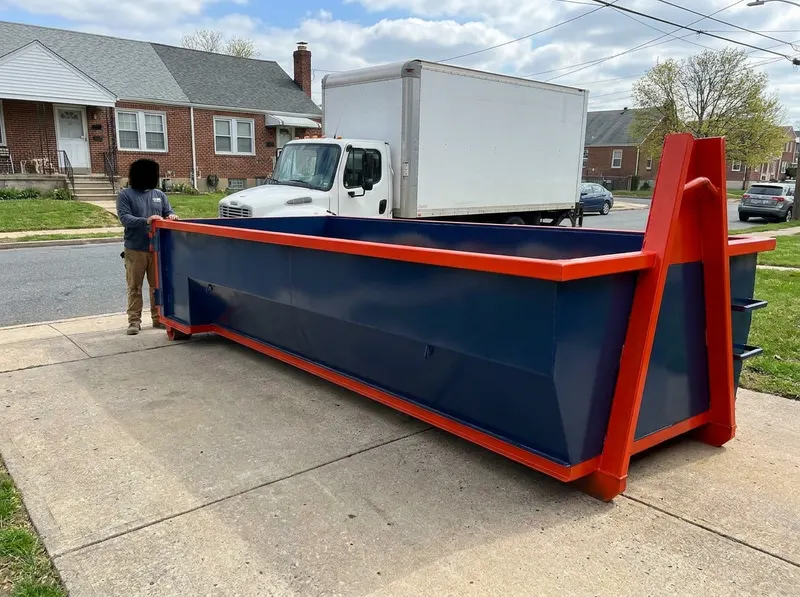
The 15-yard dumpster measures roughly 14 feet long, 7.5 feet wide, and 4.5 feet tall, holding about 15 cubic yards, the equivalent of around 6 full-size pickup loads. It is the middle size between the 10-yard ($595) and the 20-yard ($695), and it fits jobs that outgrow a single-room cleanout but do not generate roof-tear-off volume. A kitchen gut in a Fairmount row home, a two-bathroom remodel in Mount Airy, a garage and basement clear-out in Roxborough, or a mid-size flooring tear-up in South Philadelphia all tend to land inside 15 yards without paying for the larger box. The low 4.5-foot walls matter on heavier debris: you step up and drop in rather than hoisting over your head, which keeps the loading fast when you are hauling broken tile, old cabinets, or torn-out subfloor.
Sizing is a trade-off between footprint and capacity. If the job is a single-room cleanout or a small bathroom, the 10-yard at $595 saves $55 and takes less curb. If you are stripping a full roof or running a whole-house gut, the 20-yard at $695 or the 30-yard at $795 avoids a second haul. The 15-yard is the pick when you expect more than a couple of pickup loads but the debris is dense, demolition rubble, plaster, and tile fill a 15-yard before they fill the airspace of a 30-yard, so paying for extra height you cannot use is wasted money. Blue Collar Dumpster Rental confirms the right size on the phone before the box leaves the yard, so the $650 you are quoted is the $650 you pay.
Philadelphia's row-home blocks drive where the container actually sits. On tight streets in Fishtown, Northern Liberties, Point Breeze, and Port Richmond, a 15-yard drops on a driveway, a shared alley pad, or the street with the right paperwork. A dumpster placed on a public street or sidewalk in Philadelphia typically requires a permit from the Philadelphia Streets Department, and parking relief is handled through the Philadelphia Parking Authority; a private driveway in Germantown or Manayunk usually needs no permit at all. Placing the box on wood or plywood protects brick and concrete from the steel feet. Fairmount Park, the Wissahickon Valley Park corridor, and other city green space are off-limits for container placement, so the drop point stays on your lot or the permitted curb line.
What goes in is straightforward: wood, drywall, plaster, flooring, cabinets, furniture, roofing, concrete, and general construction and demolition debris. What stays out is set by regulation, the EPA guidance on household hazardous waste covers paint, solvents, motor oil, and chemicals; appliances with refrigerant, tires, and car batteries are handled separately. Electronics are banned from Pennsylvania landfills under the state's Covered Device Recycling Act enforced by the Pennsylvania DEP, so TVs and monitors do not go in the box. For reusing or recycling items instead of tossing them, Earth911 maps local drop-off options, and crews loading heavy on a worksite should follow OSHA construction jobsite standards. Fill to the top rail and not above, a load mounded over the sides cannot be legally hauled on Philadelphia roads under PennDOT load rules and will need to be leveled before pickup. The city sanitation division and the Pennsylvania DEP waste program set the disposal rules the hauler follows, and recycling-industry practices are tracked by the National Waste & Recycling Association">.
Every job gets a firm, written price after an on-site visit.
Tell us about your 15-yard dumpster rental job in Philadelphia and we'll send a clear, written quote, usually the same day.
 Blue Collar Dumpster Rental